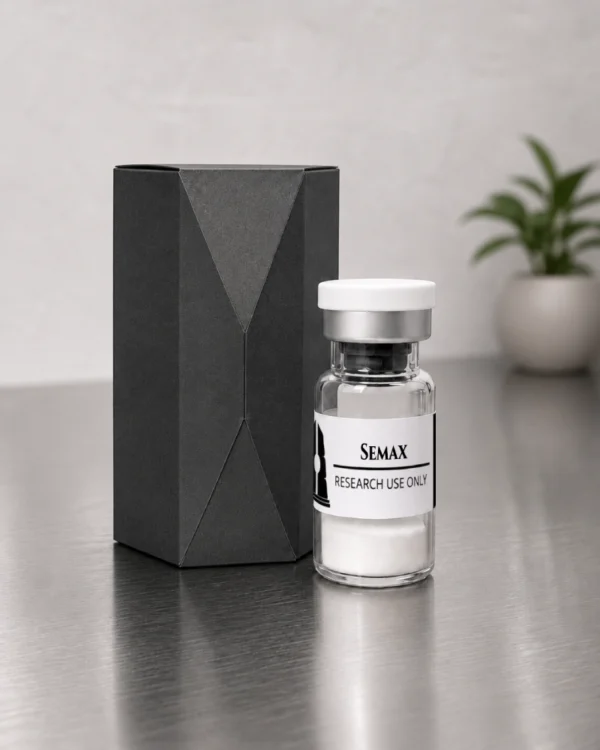
Product Overview
Semax is a seven-amino-acid analog of the ACTH(4-7) fragment, stabilized with a Pro-Gly-Pro sequence. The design preserves the core signaling interest of the ACTH fragment while improving metabolic stability for research applications.
Semax is most closely associated with brain-derived neurotrophic factor (BDNF), dopaminergic signaling, memory formation, learning, attention, and recovery after neurological stress. Researchers also examine its effects on gene expression, oxidative stress, and neuroplasticity – the brain’s ability to adapt and reorganize.
For cognitive-research projects that need more than a generic stimulant model, Semax provides a targeted peptide approach centered on growth-factor and neural-adaptation pathways.
Common Research Areas
⦁ BDNF and neurotrophic signaling
⦁ Memory, learning, and focus research
⦁ Dopaminergic pathways
⦁ Neuroplasticity
⦁ Neuroprotection and oxidative-stress models
Research References
- Kaplan AI, et al. “Semax: A novel regulatory peptide.” Annals of the New York Academy of Sciences. 1992;668:485–487. DOI: 10.1111/j.1749-6632.1992.tb35020.x.
- Dolotov OV, et al. “Semax, an ACTH(4–7) analog, increases BDNF expression in the hippocampus.” Brain Research. 2006;1118(1):1–6. DOI: 10.1016/j.brainres.2006.08.035.
- Shcherbakova LG, et al. “The effect of Semax on cognitive functions.” Neuroscience and Behavioral Physiology. 2007;37(7):711–715. DOI: 10.1007/s11055-007-0067-2.