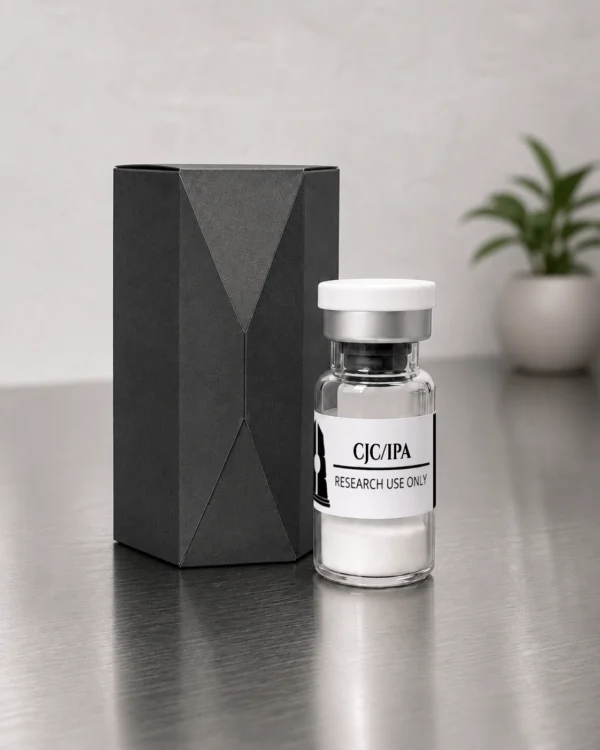
Product Overview
CJC-1295 (No DAC), more accurately described as Modified GRF (1-29), targets the growth hormone-releasing hormone pathway. Ipamorelin works through the ghrelin receptor as a selective growth hormone secretagogue. Together, they allow researchers to examine complementary signals involved in endogenous GH release.
The blend is commonly associated with research involving pulsatile growth-hormone signaling, downstream IGF-1 activity, recovery and tissue-remodeling pathways, metabolic regulation, and body-composition models. The No DAC formulation is especially relevant where shorter-acting GHRH signaling is preferred over the extended exposure associated with DAC-containing CJC-1295.
Included Compounds
- CJC-1295 (No DAC) — Modified GRF (1–29)
- Ipamorelin
Common Research Areas
⦁ Growth hormone pulse signaling
⦁ Pituitary and ghrelin-receptor pathways
⦁ IGF-1 pathway research
⦁ Recovery and tissue-remodeling models
⦁ Metabolic and body-composition research
Research References
- CJC-1295-Related Research References (Note: Some citations examine DAC-containing CJC-1295, which exhibits a significantly extended half-life compared to the No DAC variant. Findings related to DAC-containing formulations should not be assumed to be equivalent to the No DAC material.)
- Teichman SL, et al. “Prolonged pharmacokinetics and pharmacodynamics of CJC-1295, a long-acting growth hormone-releasing hormone analogue.” Journal of Clinical Endocrinology and Metabolism. 2006;91(3):795–801. DOI: 10.1210/jc.2005-1536.
- Teichman SL, et al. “Safety and tolerability of a drug affinity complex growth hormone-releasing hormone analogue in healthy subjects.” Journal of Clinical Endocrinology and Metabolism. 2006;91(7):2602–2608. DOI: 10.1210/jc.2005-2533.