Product Overview
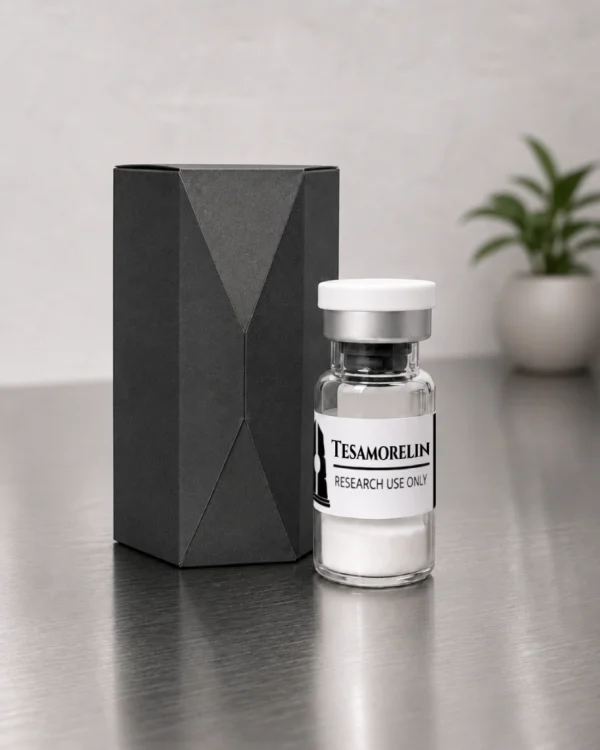
This synthetic growth hormone-releasing hormone analog is designed to activate GHRH receptors and stimulate endogenous growth-hormone secretion. That mechanism gives researchers a different model than administering GH directly: the pituitary and its natural downstream signaling remain part of the pathway.
Tesamorelin is strongly associated with studies of visceral adipose tissue, lipid metabolism, body composition, GH pulse dynamics, and downstream IGF-1 activity. Its stabilized structure extends the usefulness of native GHRH signaling while retaining a receptor-driven endocrine model.
For research focused on the relationship between the GH axis, visceral fat, and metabolic regulation, Tesamorelin is one of the most established compounds in the category.
Common Research Areas
⦁ GHRH receptor and pituitary signaling
⦁ Endogenous GH and IGF-1 pathways
⦁ Visceral-adipose research
⦁ Lipid metabolism
⦁ Body-composition models
Research References
- Falutz J, et al. “Metabolic effects of a growth hormone-releasing factor in patients with HIV.” The New England Journal of Medicine. 2007;357(23):2359-2370. DOI: 10.1056/NEJMoa072070.
- Stanley TL, Grinspoon SK. “Effects of growth hormone-releasing hormone on visceral fat, metabolic indices, and cardiovascular risk in abdominal obesity.” The Journal of Clinical Endocrinology & Metabolism. 2014;99(8):2838-2846. DOI: 10.1210/jc.2014-1610.